What Is Wing Chun? A Complete Introduction
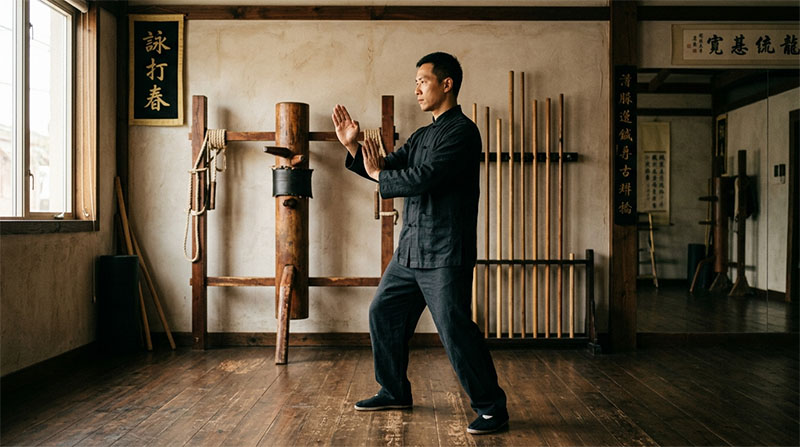
What Is Wing Chun?
Wing Chun is a traditional Southern Chinese martial art celebrated worldwide for its efficiency, directness, and practicality. Developed for close-range self-defense, it is one of the most widely practised kung fu systems in the world — and one of the most learnable. Wing Chun is the martial art that Bruce Lee studied before developing his own system, and the subject of the globally successful Ip Man film series.
The History of Wing Chun
According to Wing Chun tradition, the art was created by Ng Mui, a Shaolin nun who survived the destruction of the Shaolin Temple and distilled the most essential fighting principles into a compact, efficient system. She passed this to a young woman named Yim Wing Chun — and the art took her name. Wing Chun is one of the only major martial arts with a female founder, and its design reflects this — effectiveness without relying on size, weight, or physical strength.
The Core Principles of Wing Chun
Centerline Theory
An imaginary vertical line running through the center of your body and your opponent's. Wing Chun techniques protect your own centerline while attacking your opponent's — creating maximum efficiency and targeting the most vulnerable areas.
Economy of Motion
Wing Chun uses the shortest possible path for every technique. No wasted movement, no elaborate wind-ups. Every action serves a clear, direct purpose.
Simultaneous Attack and Defense
Most martial arts teach block then counterattack. Wing Chun teaches both at exactly the same time — saving critical time and continuously pressuring the opponent.
Structure Over Strength
Wing Chun power comes from structural alignment — not muscular effort. A smaller practitioner can generate significant force and redirect a larger attacker's power without needing to match them physically.
The Wing Chun Curriculum
- Siu Nim Tao — foundational first form covering structure, relaxation, and basic hand techniques
- Chum Kiu — second form introducing footwork, turning, and integration of body mass
- Biu Tze — third form covering emergency techniques and advanced striking
- Mook Yan Jong — wooden dummy form for precision and application
- Luk Dim Boon Kwan — Dragon Pole form
- Bart Cham Dao — Butterfly Swords form
Frequently Asked Questions
What is Wing Chun?
A traditional Southern Chinese martial art known for efficiency, directness, and practicality. Developed for close-range self-defense using centerline theory, economy of motion, and structure over strength.
Who created Wing Chun?
According to tradition, Ng Mui — a Shaolin nun — who passed it to Yim Wing Chun, from whom the style takes its name.
What are the main principles of Wing Chun?
Centerline theory, economy of motion, simultaneous attack and defense, structure over strength, and sensitivity through chi sao.
Is Wing Chun good for beginners?
Yes — one of the best martial arts for beginners. Its compact curriculum starts with Siu Nim Tao which requires no athleticism or prior experience.
Ready to start? Download the free Siu Nim Tao eBook or explore the full Wing Chun online training and certification program.