Kung Fu Kendra on Not Nosey Just Curious: Wing Chun, Ego, and Why Smarts Beat Strength
A Conversation Built for Curious Minds
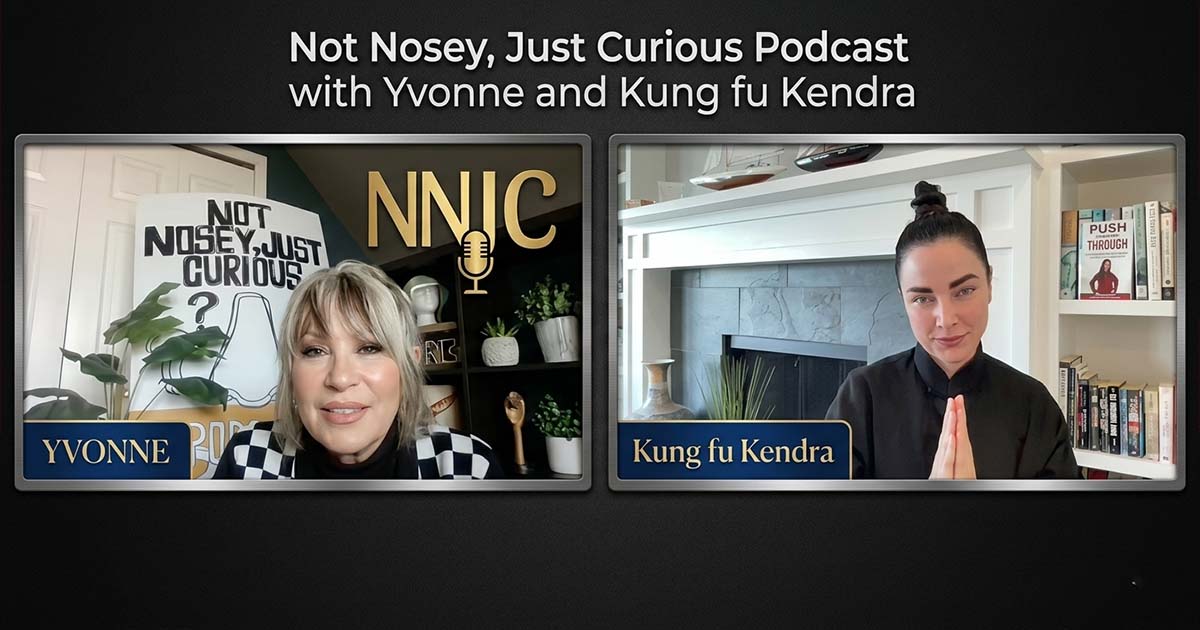
Kung Fu Kendra — Kendra Mahon — recently appeared on the Not Nosey Just Curious podcast for a conversation that cut right to the heart of what Wing Chun is and why it works. The host came to the interview genuinely curious — asking questions that many people wonder about but rarely get answered clearly: Is kung fu spiritual? Is it methodical? What actually makes it different? Kendra's answers were some of the clearest and most compelling she has given on any platform.
She introduced herself as a third-generation master in the Ip Man lineage of Wing Chun — the same lineage that gave the world Bruce Lee — and founder of the Global Kung Fu Alliance, now with over 250,000 members worldwide. But the interview quickly moved past credentials into the substance of what Wing Chun actually teaches and why it is distinctly different from every other martial art.
Kung Fu Means Skill — Not Fighting
"Kung fu is a very mind and body correlation art," Kendra explained. "It emphasises the yin and the yang — to create a style that ultimately means skill." This is a point she makes consistently and that most people genuinely do not know: kung fu does not mean fighting. It means skill. Any discipline pursued with dedication and effort over time qualifies — a master craftsman practising kung fu, a musician practising kung fu, a martial artist practising kung fu. The Chinese martial arts tradition uses the term to describe the quality of mastery earned through consistent, intentional effort.
For Wing Chun specifically, that skill is the ability to protect yourself and others efficiently, intelligently, and with the minimum necessary force. "Kung fu is to seek peace," Kendra told the host, "and to find a way to harness that peace without the fight." It is the opposite of aggression. It is the cultivation of capability in service of calm.
Wing Chun: Created by a Woman, Built for Anyone
When the conversation turned to Wing Chun specifically, Kendra shared the founding story that consistently surprises people: the art was created by a woman. Over 300 years ago, a Shaolin Buddhist nun named Ng Mui developed this system during the Qing Dynasty because she was small and needed to defend against larger warriors. She had access to the complete Shaolin martial library — but she did not want a system that depended on athletic power. She wanted a system based on physics, strategy, and intelligence.
The result was Wing Chun: a close-range system that works by redirecting force rather than meeting it head on, by targeting the most vulnerable anatomical points rather than brawling, and by using an opponent's momentum and energy against them. "It's the perfect style to be a smaller person against a larger person," Kendra explained. "You're learning to use their energy against them — to manoeuvre that energy or qi to gain control of a situation." This is what the host summarised perfectly at the end of the exchange: "It's not about strength — it's about smarts." Kendra confirmed immediately: "Absolutely."
The Ego Is the Real Enemy
One of the most important lessons from the Not Nosey Just Curious conversation was Kendra's discussion of ego in conflict. She made a point that is counterintuitive but critically important: in a threatening situation, the biggest danger is often not the attacker. It is your own ego. "When you go off, get angry, or get triggered — that's your ego," she explained. "And when your ego comes into the picture, a lot can go wrong."
She illustrated this with a relatable example: the way people trip or stumble when they know someone is watching. They perform for the audience rather than moving naturally, and the ego-driven self-consciousness degrades their coordination. In a self-defense situation, the same mechanism plays out at a higher stakes level. Ego-driven reactions — anger, bravado, the need to prove something — cloud perception, slow response time, and lead to escalation that serves no one. Wing Chun trains this out of you. Years of practice under pressure, in forms, in chi sao, and in sparring, develop the ability to stay calm and centred regardless of what is happening around you. The response becomes intelligent rather than reactive.
I Do Not Encourage My Students to Look for Fights
Kendra was also clear — as she always is — about the purpose of all this capability. "I do not encourage any of my students or anyone that I work with to look for fights or to show people how tough you are with your moves," she told the host. "There's no point in looking for a fight because that does not end up well." Wing Chun training gives you extraordinary physical tools. The wisdom of the tradition tells you to use those tools only when truly necessary — and to spend your energy developing the awareness and presence that makes necessary confrontations rare to begin with.
This is the full picture of Wing Chun as Kendra teaches it: not a license for aggression, but a foundation for genuine capability, intelligent response, and the quiet confidence of someone who knows they can handle themselves — and therefore almost never needs to. Everything Kendra teaches is available at KungFuKendra.com.
Put the smarts to work. Start building real Wing Chun skill with Kung Fu Kendra's online Wing Chun certification — the world's first fully accredited online Wing Chun curriculum, available to students anywhere in the world.
Frequently Asked Questions
Is Wing Chun effective for self-defense?
Yes. Wing Chun is designed for close-range, real-world self-defense — allowing a smaller person to defeat a larger attacker through mechanics and economy of motion, not strength. It is one of the most practical self-defense systems in the world.
Why is ego dangerous in a self-defense situation?
Kung Fu Kendra teaches that ego causes reactive, emotionally driven responses that cloud judgment under pressure. Wing Chun trains practitioners to stay calm and centred — replacing ego-driven reaction with intelligent, efficient action.
What does economy of motion mean in Wing Chun?
Economy of motion means achieving maximum effect with minimum energy and movement. In Wing Chun, this means neutralising a threat in as few moves as possible — efficiently, directly, and without wasted effort.
Who created Wing Chun kung fu?
Wing Chun was created by a female Shaolin Buddhist nun named Ng Mui approximately 300 years ago. She designed the system so a smaller person could defeat a larger opponent — making it ideal for women and anyone who cannot rely on size and strength.
What does kung fu mean?
Kung fu literally means skill in Chinese — any discipline pursued with dedication and effort over time. It does not refer to a specific fighting style, but to the quality of mastery developed through consistent practice.
Start the Wing Chun Online Certification Course
The complete Wing Chun system taught by a 3rd Generation Ip Man lineage master. No partner needed, no local school required. Beginner to certified Sifu — fully online.
View the Course →