Kung Fu Kendra on the Zen and Now Podcast: Wing Chun as a Practical Art for Everyday Life
A Host Who Understood the Depth of the Art
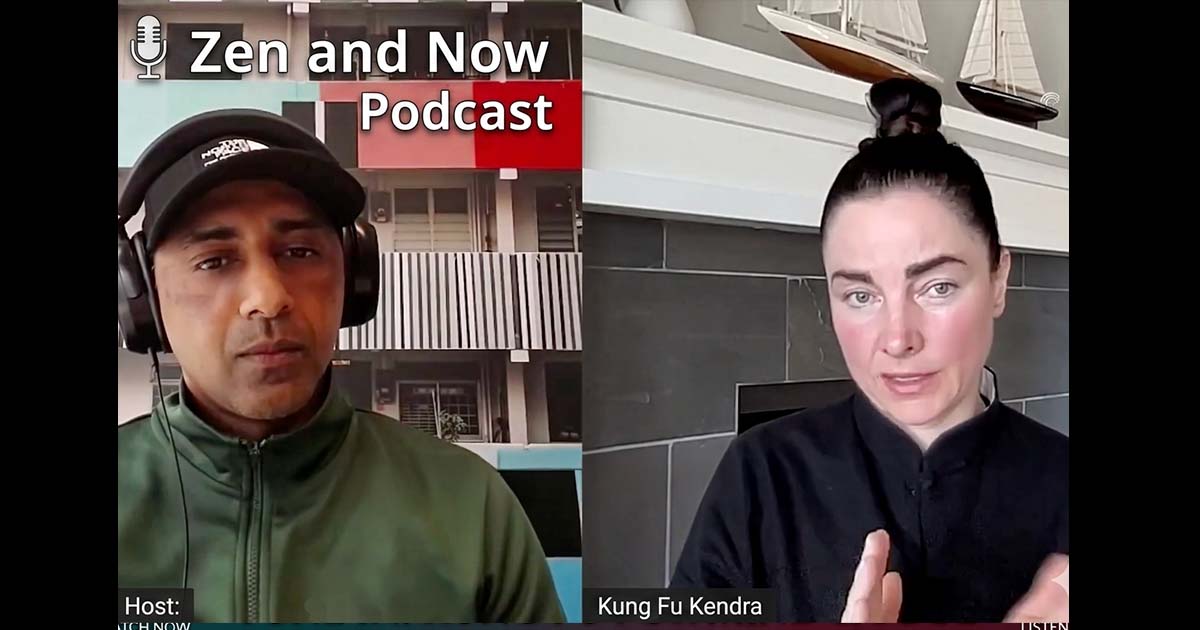
The Zen and Now podcast welcomed Kung Fu Kendra — Kendra Mahon — as its featured guest for what became one of the most philosophically rich conversations she has given on any platform. The host — who grew up watching the Ip Man films and has a genuine appreciation for martial arts as more than combat — brought an intellectual curiosity and warmth to the interview that allowed Kendra to go deeper than the usual credentials and curriculum overview. What emerged was a conversation about Wing Chun as a philosophy of life — a way of being in the world that produces calm, capability, and a quality of presence most people only glimpse occasionally.
He introduced Kendra as a third-generation master in the Ip Man lineage with over 23 years of kung fu experience, founder of the Global Kung Fu Alliance, author of Push Your Way Through, and the instructor behind a five-star Wing Chun program with students worldwide. His first question — about where the passion for kung fu began — opened the door to the origin story that underpins everything.
The Origin: A Young Person Who Needed to Feel Safe
Kendra described starting Wing Chun over 23 years ago, at a young age, after being attacked. "I realised how important it was for people to learn how to use their body as a way to protect themselves," she told the host. "I thought: I need to first of all learn self-defense." What she found in Wing Chun went far beyond that original intention. Over the years, she experienced the full transformation that the art is capable of producing — not just physical capability, but a deep internal shift in how she related to herself and the world. "It's a pleasure now to be in a situation where I can teach and promote the art and encourage people to learn how to defend themselves."
Why Wing Chun Is Different From Every Other Art
The host asked Kendra to explain what makes Wing Chun distinct — particularly in contrast to the many styles shown in the Ip Man films. Her answer was direct and clear: "A lot of kung fu and martial arts are a lot for show. Karate, taekwondo — they're competition-based. Whereas Wing Chun is a practical, easy-to-learn art that's good for everyday life." This is not a dismissal of other arts. It is an acknowledgement of what they were designed for. Wing Chun's designers asked one question: in a real encounter, what actually works? The 300-year answer — refined through continuous practice and development — is a close-range, physics-based system that requires no athletic dominance and can be used by anyone.
She also gave the host a vivid illustration of Wing Chun's practical philosophy: "Wing Chun is not about 'let's just start fighting back and forth.' It's: oh my god, I'm being attacked. I'm going to get out of it and I'm going to go get help." The goal is escape and safety, not combat dominance. And to be clear: this is not a lack of capability. Kendra trains to the highest level of the art. "That's not to say I'm not trained to poke someone's eyes out — that's one of our techniques." But the wisdom of the tradition points toward using capability to avoid fights, not to win them.
Reading Energy: The Highest Expression of Wing Chun
One of the most compelling moments of the Zen and Now episode was Kendra explaining what she described as knowing how not to get in the fight — an ability developed through years of Chi Sao (sticky hands) training and internal practice. "You know how to read energy because you've done so much work from the inside out that you've learned to not get in the fight." This capacity to sense an incoming threat before it fully develops, and to respond by redirecting or removing yourself rather than engaging — is the highest practical expression of everything Wing Chun trains. It is not passivity. It is the fruit of deep active practice.
The host articulated it beautifully at the end of the episode: "Wing Chun is not just a discipline or a tool to protect yourself — it's a way of life that brings so much calm and peace." Kendra confirmed this completely. After more than 23 years, Wing Chun is not something she does — it is part of who she is. And she has built a platform to share that transformation with anyone in the world who is ready to seek it at KungFuKendra.com.
Make Wing Chun a part of your everyday life — explore Kung Fu Kendra's complete Wing Chun online course — the world's first fully accredited online Wing Chun curriculum, available to students anywhere in the world.
Frequently Asked Questions
How is Wing Chun practical for everyday life?
Wing Chun is practical for everyday life because it was designed for real-world encounters, and its principles — economy of motion, staying centred, reading energy — translate directly into how practitioners navigate daily challenges and decisions.
What does reading energy mean in Wing Chun?
Reading energy refers to the sensitivity developed through Chi Sao training — the ability to sense and respond to force, intent, and momentum through contact. Over years, this extends into a general awareness of interpersonal dynamics and potential threats before they fully develop.
Why is Wing Chun not a sport?
Wing Chun has no competitive application — its techniques target vulnerable anatomical points and are designed to end encounters quickly. This makes them inappropriate for sport but highly effective for genuine self-protection.
What is Wing Chun's connection to peace and zen philosophy?
Wing Chun is rooted in the same tradition as Zen — inner stillness, present-moment awareness, and action that flows from a centred mind. The Zen and Now host noted that it is not just a self-defense tool but a way of life that brings genuine calm and peace.
What happened after Kung Fu Kendra lost her mother?
After losing her mother, Kendra channelled grief into continued building — deepening programs, growing her community, and establishing the Bonnie Atkins Memorial Scholarship. Her mother's final words — that she was proud — became the ongoing motivation to honour that pride through her work.
Start the Wing Chun Online Certification Course
The complete Wing Chun system taught by a 3rd Generation Ip Man lineage master. No partner needed, no local school required. Beginner to certified Sifu — fully online.
View the Course →