Wing Chun vs Taekwondo: Which Is Better for Self Defense?
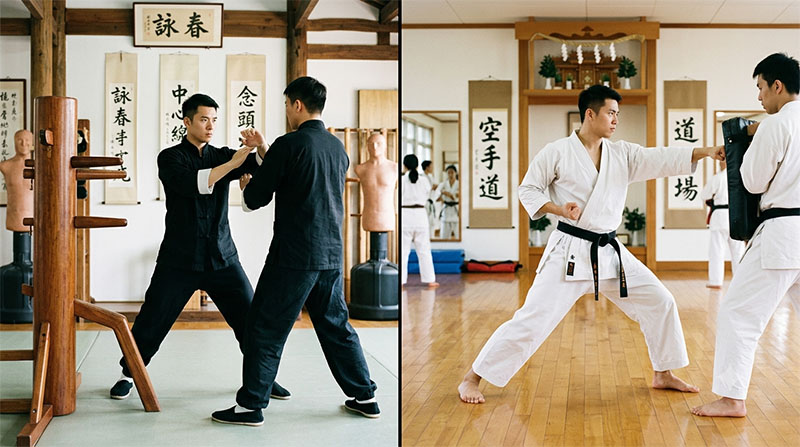
Two Arts Built for Different Ranges
Wing Chun and Taekwondo represent opposite ends of the striking range spectrum. Taekwondo is built around long-range kicking — fast, powerful, and visually spectacular. Wing Chun is built around close-range efficiency — compact, simultaneous, and structurally grounded. Understanding this fundamental difference tells you most of what you need to know about how they compare.
The Core Differences
Range and Distance
Taekwondo excels at the distance where full kicks can be deployed — roughly one to two body lengths from the opponent. Its techniques require room to chamber, extend, and retract. Wing Chun excels in the range where most real encounters occur — close enough to touch, close enough that large movements become impossible. Wing Chun's punches, palm strikes, and low kicks all operate inside the range where Taekwondo kicks lose effectiveness.
Kicking Philosophy
Taekwondo places kicking at the center of the system — high kicks, spinning kicks, jumping kicks. These techniques are athletic and powerful when the distance and timing are right. Wing Chun's kicking philosophy is minimalist by design: kicks are exclusively low, targeting the knee, shin, and ankle. The reasoning is practical — low kicks are faster, harder to see, and do not compromise your balance the way high kicks do.
Sport vs Self-Defense
Modern Taekwondo has a strong sport tradition with Olympic competition. Sport Taekwondo emphasizes point scoring and controlled environments with specific rules that shape the techniques trained. Wing Chun has no sport tradition — it was developed for self-defense against uncontrolled opponents and has remained focused on that application throughout its history.
Simultaneous Attack and Defense
Wing Chun's core tactical principle is simultaneous attack and defense — the same movement that deflects an incoming attack also initiates a counter. Taekwondo traditionally separates defense and offense into sequential actions. In a real encounter where time is critical, the simultaneous approach has a structural advantage.
Which Is Right for You?
- Choose Wing Chun if: you want close-range self-defense, do not want to rely on athleticism, prefer a logical compact system, or want to train at home
- Choose Taekwondo if: you enjoy sport competition, want to develop powerful kicking, or are drawn to the Olympic tradition
- Consider both if: you want to cover both long and short range — the two systems genuinely complement each other
Frequently Asked Questions
Is Wing Chun better than Taekwondo for self defense?
For close-range self-defense, Wing Chun has a structural advantage. Most real encounters happen at close range where Taekwondo's long-range kicks are difficult to deploy. Wing Chun is specifically designed for that close-range scenario.
What is the difference between Wing Chun and Taekwondo?
Wing Chun is a Chinese close-range system using compact hand techniques, low kicks, and simultaneous attack-defense. Taekwondo is a Korean art famous for high fast kicks with a strong sport and Olympic tradition.
Does Taekwondo work in a real fight?
Taekwondo kicks can be effective but require space and timing that real situations often do not provide. At close range, Taekwondo practitioners have less to draw on than practitioners of close-range systems like Wing Chun.
Can you combine Wing Chun and Taekwondo?
Yes — Wing Chun's close-range tools complement Taekwondo's long-range kicking well. The combination covers a wider range of distances than either system alone.
Interested in Wing Chun's close-range system? Enroll in the Wing Chun Online Certification Course.